
Timing Belt vs. Serpentine Belt: What’s the Difference and Which One Does Your Car Have?
A high-pitched squeal when you start your car, or a new ticking sound under the hood, can leave you wondering: is it a belt, and how urgent is it? The answer depends on which belt you’re hearing. Your engine may have both a serpentine belt and a timing belt, but they do very different jobs.
Knowing the difference can help you describe the symptom, understand what a technician is checking, and avoid putting off maintenance that protects your engine.
Timing belt vs. serpentine belt: the basic difference
The serpentine belt is an external drive belt that powers accessories. The timing belt is inside a covered area of the engine and keeps internal engine parts moving in sync. One usually affects accessories when it fails; the other can affect whether the engine runs at all.
| Serpentine belt | Timing belt | |
|---|---|---|
| Main job | Turns engine accessories | Synchronizes the crankshaft and camshaft |
| Typical location | Visible on the outside of the engine | Usually behind a protective cover |
| Common failure clues | Squealing, chirping, or accessory problems | Possible ticking, rough running, misfiring, or no-start |
| Replacement schedule | Inspect and replace based on wear and vehicle guidance | Follow the vehicle-specific scheduled interval |
What does a serpentine belt do?
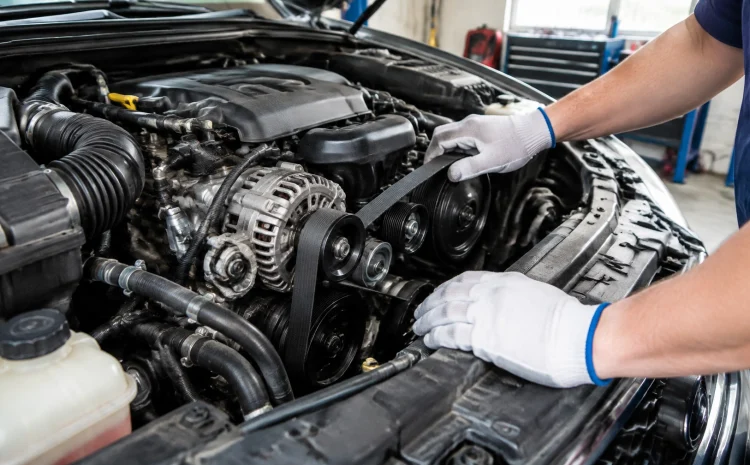
The serpentine belt loops around pulleys to transfer power from the engine to accessories. Depending on your vehicle’s design, it may drive the alternator, air-conditioning compressor, power-steering pump, and sometimes the water pump.
That last detail matters: not every engine’s water pump is driven by the serpentine belt. Some use a different arrangement. If a belt comes off or breaks, you may lose charging, air conditioning, or power steering. If that belt drives the water pump, the engine may also overheat. The exact effects depend on your vehicle.
Signs of a serpentine belt problem
Listen for a squeal or chirp from the engine area, particularly at startup or when switching on the A/C. You might also notice a battery or charging warning, heavier steering, or air conditioning that stops working.
With the engine off, a technician can inspect the belt and its related pulleys. Cracks, fraying, glazing, or missing rib material can indicate wear, but modern belts may not show obvious cracks even when worn. Noise can also come from a pulley or tensioner, so replacing the belt without checking the surrounding parts may not solve the problem.
If the belt breaks while you’re driving, find a safe place to stop. Don’t keep going if the engine temperature rises, a warning light appears, or steering becomes difficult.
What does a timing belt do?
The timing belt synchronizes the crankshaft and camshaft so the pistons and valves move in the correct sequence. Because the timing has to be precise, a belt that stretches, skips teeth, or breaks can cause the engine to run poorly or stop.
Some vehicles use a timing belt; others use a timing chain. You can’t reliably tell which one your car has just by looking under the hood. Check your owner’s manual or have a technician confirm it using your vehicle’s details.
Timing belt failure can be serious
If a timing belt breaks, the engine may stall and fail to restart. On an interference engine, the pistons and valves can occupy overlapping space at different points in the cycle. If timing is lost while the engine is running, they may collide, potentially causing extensive internal damage.
That risk is specific to the engine design. Not every engine is an interference engine, and the exact setup should be confirmed for your vehicle. Because a timing belt is usually hidden behind a cover, you may not get a clear visual warning before it fails.
A ticking sound near the timing cover, rough running, misfires, or loss of power deserve attention, but none proves on its own that the timing belt is the cause. Other engine problems can produce similar symptoms. For more on how warning signs are diagnosed, see our guide to what your car may be telling you about engine repair.

When should each belt be replaced?
Timing belt: follow the exact service schedule
There is no one mileage interval that fits every timing belt. The replacement schedule depends on the vehicle and engine, and some manufacturers specify a time limit as well as a mileage limit. Check your owner’s manual or ask a technician to confirm the schedule for your specific vehicle.
Don’t wait for a noise or visible damage to decide whether a scheduled timing belt is due. Since the belt is covered, a routine glance under the hood usually won’t tell you enough about its condition. If you’ve bought a used vehicle and can’t confirm when the belt was last replaced, get the maintenance history checked.
A timing belt service may involve more than the belt itself. Depending on the engine and the parts’ condition, the job may include tensioners, idler pulleys, or a water pump. Replacing related parts when appropriate can help avoid paying for overlapping labor later.
Serpentine belt: inspect condition and related parts
Serpentine belts don’t share a universal replacement mileage. Follow your vehicle’s maintenance guidance and have the belt inspected for wear. Because visible cracks aren’t always present on modern belts, a professional may use a wear-measuring tool and check the tensioner and pulleys as well.
If you hear a chirp or squeal, or notice that charging, steering, or A/C performance has changed, arrange an inspection rather than assuming the belt alone is at fault.
Why timing belt replacement usually costs more
A serpentine belt is generally more accessible. A technician still needs to confirm the belt size, routing, tensioner, and pulley condition, but the job is often more straightforward.
A timing belt is behind protective covers, and replacement requires careful access and precise alignment. The technician must set engine timing correctly and may recommend replacing related parts while the area is accessible. That added labor and parts are why serpentine belt replacement cost and timing belt service costs can differ substantially.
The actual price depends on your vehicle’s engine, the parts needed, and the labor involved. Ask for an estimate that explains what is included and whether related components need attention. A clear estimate is more useful than a generic price that may not fit your car.
The practical solution: identify the belt, then follow the right plan
A squealing accessory belt and a worn timing belt are not the same problem, and one cannot tell you the condition of the other. If you hear a new noise, notice engine misbehavior, or aren’t sure when a timing belt was last changed:
- Note when the noise happens and any warning lights or performance changes.
- Avoid reaching near belts or pulleys while the engine is running.
- Check your owner’s manual or service records for the timing belt schedule.
- Have a technician identify the cause and inspect the belt system.
For drivers in Pantego, TX, Monart Motors can inspect belt-related symptoms, explain what the findings mean, and discuss the service options before work begins. Visit our contact page to schedule an appointment or call 817-966-6709. We’re at 1924 W Pioneer Pkwy Ste A, Pantego, TX 76013.
